
About the author :– John Berger (1926-2017) was an English art critic, novelist, and painter. He was a prominent figure in the British art world in the 1950s and 60s, and later became known for his politically-engaged writing on art and society. Berger’s work often explored issues of social justice, power, and identity, and he was a vocal critic of capitalism and imperialism. In addition to “Ways of Seeing,” his most famous works include the novel “G.,” the essay collection “About Looking,” and the memoir “Here Is Where We Meet.” Berger’s contributions to the world of art and culture continue to be widely recognized and celebrated.
The novel :- “Ways of Seeing”
John Berger’s groundbreaking book “Ways of Seeing” is a seminal work of art criticism that examines how we perceive and interpret visual images. Published in 1972, the book has since become a classic, inspiring generations of artists, writers, and thinkers to re-examine the way they view the world.
At its core, “Ways of Seeing” is an exploration of perception – how we see things and what influences our understanding of what we see. Berger argues that our perception of the world is shaped by a complex web of social, cultural, and historical factors, and that these factors work together to create the way we understand visual images.
One of the key insights of “Ways of Seeing” is that our perception of images is not neutral or objective – it is always influenced by our personal biases and cultural assumptions. Berger illustrates this point by analyzing a range of visual images, from traditional oil paintings to modern advertisements. He shows how the way we interpret these images is influenced by factors such as class, gender, and race, and how these interpretations can be challenged and subverted by artists who seek to disrupt the dominant cultural narratives.
Berger also examines the role of the artist in shaping our perceptions of the world. He argues that the artist has a responsibility to challenge the dominant cultural narratives and to create new ways of seeing. He notes that many artists throughout history have used their work to challenge the status quo and to push for social and political change.
“Ways of Seeing” also explores the ways in which visual images are used to reinforce and perpetuate power structures. Berger shows how the representation of women in visual images is often based on patriarchal assumptions and reinforces gendered power imbalances. He also notes how images of non-Western cultures can be used to exoticize and marginalize these cultures, reinforcing colonialist power structures.
Ultimately, “Ways of Seeing” is a call to action for all of us to become more aware of how we perceive the world around us. Berger challenges us to question our assumptions and biases, and to work towards creating new ways of seeing that are more inclusive and equitable.
In conclusion, “Ways of Seeing” is a thought-provoking and insightful exploration of perception and visual culture. Berger’s analysis is as relevant today as it was when the book was first published, and it continues to inspire new generations of artists and thinkers to challenge the dominant cultural narratives and to create new ways of seeing the world.
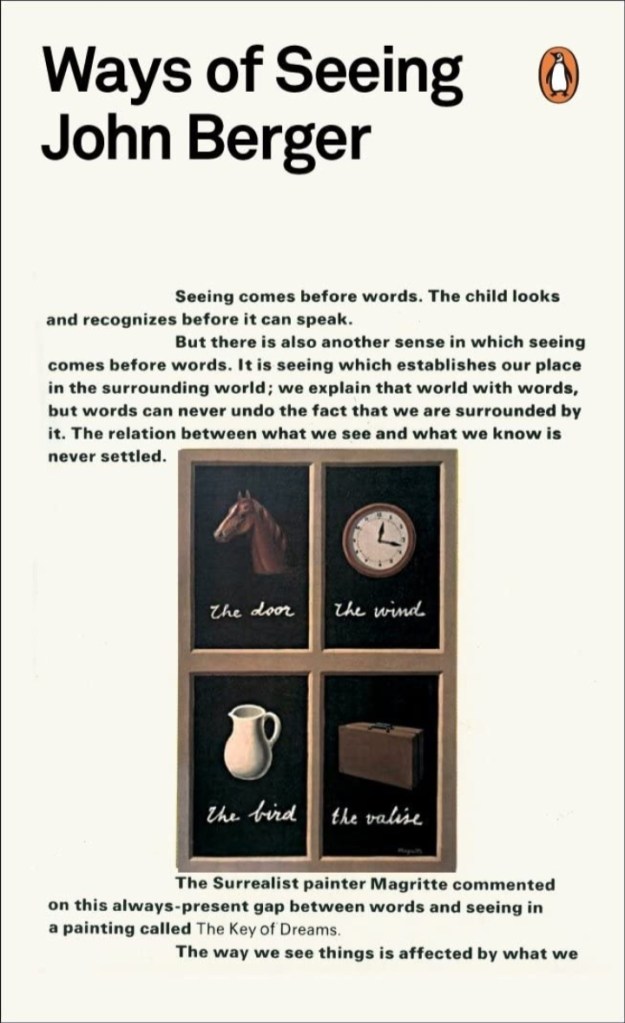
“See the World in a Whole New Way with John Berger’s ‘Ways of Seeing’ – the groundbreaking book that will change the way you look at art, culture, and society!”















 The Book Shelf